
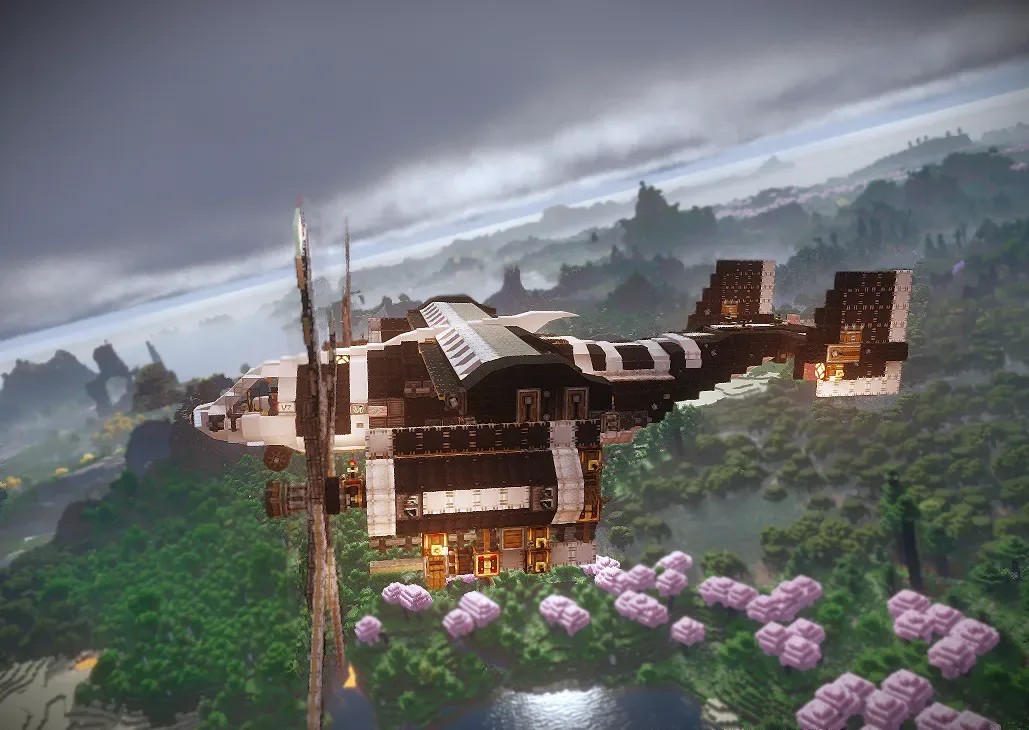
| Creator | Edgeworthmuzzry |
|---|---|
| Category | Flying Machines |
| Size | 57 × 17 × 42 blocks |
| Blocks | 2,325 |
| Minecraft | 1.21.X |
| Create | 6.0.10 |
| Mods | Simulated, Offroad, Aeronautics, Copycats, Create |
| Downloads | 1,177 |
| Added | 2026-10-01 |
Schematic by Edgeworthmuzzry, published on CreateMod.com. This page lists what it contains; download the file from the creator’s page.
This is a transport aircraft that can freely switch between VTOL and fixed-wing modes, capable of independent and stable flight in both forms. It is based on the V-22 Osprey, adapted structurally to fit the Create mod's power logic, with unique Minecraft aesthetic touches.
Download & Deployment
The Copycats+ mod is required. The copycat blocks provided by Create: Connected cannot fully replace them (The 13th time. The guest list for The Last Supper is finally complete).
If you have the Photomancy mod, you can download the add-on file pgv72.nbt-assembled version, drop it into the sable-schematics folder, and load the fully assembled physicalized version directly.
Of course, the standard schematic is also easy to deploy and assemble—but remember this order: after deployment, physicalize/assemble first, then load fuel. If you reverse the order, it probably won't break, but the plane will leap like a frog after assembly (about 50 meters high. If you're on the Moon, it might just reach escape velocity).
Startup, Entry & Preparation
After fueling two of the engines on the outside (coal is fine. I'm an eco-destroyer who loves fossil fuels), go to the "neck" of the plane (front lower part of the wings), on either side. You'll see a button on the hull. Press it, and the hatch will open and turn into stairs. You can walk up with dignity, instead of cosplaying a pull-up superhero like in some of my previous works.
Once aboard, before looking for a seat, follow the signs and input fuel for both left and right engines. There's a chest on each side of the cargo bay wall. Put fuel inside (coal again. At least 14 for the left, 15 for the right). Wait about ten seconds for the fuel to auto-load completely. While waiting, walk to the rear of the cargo bay and press the button on the wall to activate and close the ramp door.
About Driving
In the cockpit, there are two typewriters. Their keybinds are:
W/S: Pitch up / down
A/D: Roll left / right
I/K: Accelerate / decelerate
J/L: Yaw left / right
Although they control driving in different modes, the keybinds are identical. In VTOL mode (default), use the left typewriter. In fixed-wing mode, use the right typewriter.
There are also three levers in the cockpit:
Left lever: Disables propeller gyroscope function (in VTOL mode)
Right lever: Turns on navigation lights
Middle lever: Toggles between VTOL / Fixed-wing flight mode
Indicator light between the cockpit and tail: Indicates propeller speed. 15 means the propeller is stopped, 0 means maximum propeller speed.
I will promptly add a schematic for a wireless redstone receiver array board in the add-on files for convenient keybind modification.
Some Driving Tips & Notes:
1.In VTOL mode, if you accelerate and climb too quickly, steering, pitching, and other operations will become sluggish. So take off gently.
2.In VTOL mode, if you find the plane unstable or out of control (e.g., pressing the dive key makes the plane pitch up instead), stop all inputs for two seconds and let the propeller gyroscope handle it—unless you've used your superior skills to flip the plane 180 degrees.
3.The middle lever: whichever way its tip points, use the typewriter on that side to drive.
Finally, My Thoughts
This plane took me three days to make. Day one: I completed the fuselage, power system, operating system, exterior, and interior. The remaining two days were spent on that damn propeller—yes, those two stinky propellers at the wingtips. To achieve true free switching between VTOL/fixed-wing and normal flight, I iterated through over twenty versions, drank three cans of hormone drinks (I just wanted to drink them), and stayed up until 2 AM UTC+8 two nights in a row (yep, I started working on that crappy propeller the very first night).
Finally, at 16:33 UTC+8, I successfully created a propeller structure capable of VTOL mode switching and normal flight. At 17:24, I completed schematic assembly testing. At 17:31, I finished capturing gallery screenshots—but before that, God knows what I went through.
It was on the afternoon of September 29th, UTC+8, that I decided to officially start building a VTOL transport based on the V-22 Osprey. I was full of confidence at first. After all, I had designed so many beautiful tanks, armored vehicles, and aircraft. I decided to continue my detail-obsessed persona: I wanted the interior to hold a car, the wings to rotate and fold when parked, three remote turrets, and a single-typewriter dual-mode driving system via precise redstone circuits... I wanted to perfect every detail.
Work began. I quickly built the power chassis, shell, interior, and basic wing control system. It looked decent—already a cool-looking plane. But on the first test flight, it continuously pitched backward, performing five or six backflips. So I tried adding a bit of weight to the nose—but with little effect. It could balance while hovering, but during climbs, it pitched up violently, and during freefall, it plummeted head-first like a missile. Through repeated experiments and observation, I realized it was due to the tail elevators having too large a surface area, causing excessive drag at the rear during climbs. Thus, on the first night, I achieved normal flight in VTOL mode.
On the second day, I tried switching to fixed-wing mode—no matter the position, angle, or speed, once switched to fixed-wing, it began uncontrollably front-flipping. I started adjusting the center of gravity, reducing weight, changing sail distribution, adjusting the propeller structure... A whole day of constant testing and adjusting yielded almost nothing. All my previous pursuit of detail—landing gear, parking bay, turrets, folding wings—almost all compromised and abandoned. At that moment, I finally realized my own weakness and ignorance. Countless experiments yielded no successful structure, and instead made me realize the VTOL propeller designed on day one had to be scrapped entirely.
But I vaguely sensed where the problem lay. In my old work, the "BZR0" rocket launch pad, I used physical structure collisions to make physical bearings lift super-heavy objects—it's the exact same principle. The force interaction between physical structures is very special; their method of applying force is extremely bizarre—impossible to design using standard force analysis.
By the third day, I was mentally and physically exhausted, almost unable to design any new structures. I started browsing and downloading previous creators' V-22s to see if I could find some reference—turns out everyone faced the same problem. They either made it purely decorative or reduced the rotation angle of the propellers during switching... None achieved true dual-mode free switching and independent stable flight.
No choice but to design it myself. Redesign after redesign, iteration after iteration, repeating disassemble, flip, modify, install... Sometimes an accidental structural break meant redoing everything. Sometimes an iteration looked exactly like a previously scrapped version... After 9 continuous hours, at 16:33 UTC+8, I designed a successful structure—at this point, I felt something not quite like happiness, but a kind of numbness. I flew my plane, switched modes back and forth, flew around, circled again and again. For over half an hour, I just flew aimlessly. My save file grew by several GBs.
In short, the current look of the wings and propellers might seem a bit strange—but this is the optimal power-engineering solution after countless experiments over two days and nights. I've tried my best to make it look less ugly. After arguing with this crappy propeller for two days, I've almost lost my ability to organize language normally—God knows what I just said in that massive paragraph, but I feel much better after saying it.
Have fun, and feel free to leave a comment if you have any questions.
这是一架可以自由切换垂直起降与固定翼模式的运输机, 在双形态皆可独立稳定飞行。原型为 V-22倾转旋翼机“鱼鹰”【Boeing Bell V-22 Osprey】 。根据 minecraft create 模组的动力逻辑适应性地调整了一些零件结构, 并加上了独属于 minecraft 的美学点缀。
下载与部署
copycat+ 模组是必须的, create:connnected 里的伪装方块无法完全替代 (第十三次, 凑齐最后的晚餐的人数了) 。如果你有 photomancy 模组, 可以下载附加文件 “pgv72.nbt-assembled version“, 拖入sable-schematics文件夹,直接加载物理化组装完成的版本。
当然,如果是普通版原理图也很容易部署组装 —— 但记住这个顺序: 部署后, 先物理组装, 再装填燃料 —— 当然如果顺序反了也大概率不会损坏, 只是飞机会在组装后会像青蛙一样一跃而起(大概跳个五十几米高吧, 如果在月球也许能直接逃逸月球的重力)。
启动,进入 与 准备
在外侧为其中两个引擎装填了燃料(煤炭即可, 我是热爱化石燃料的环保破坏者)后, 就可以来到飞机的脖子旁(机翼前下方), 两侧都可以, 可以看到外壳壁上的按钮 —— 按下它, 舱门就会打开并变成楼梯, 你就可以体面地走上去, 而不是再像我的某些往期作品一样需要cosplay单杠超人了。
爬上飞机以后第一件事, 在寻找座位之前, 你需要根据告示牌的指引, 为左右两侧的引擎都输入燃料 —— 在货舱的左右舱壁上各有一个箱子, 需要往里面投入燃料(还是煤炭, 左侧至少14个, 右侧至少15个), 等待十秒左右, 燃料就能完全自动装填完毕了 —— 在等待期间, 你可以往货舱尾部走, 按下舱壁上的按钮来激活并关好坡道尾门。
关于驾驶
在驾驶室, 有两台打字机, 它们的键位如下:
W/S:上仰/俯冲
A/D:左/右 翻滚
I/K:加速/减速
J/L:左/右 偏航
虽然它们负责的是不同形态下的驾驶, 但键位操作相同。垂直起降模式(默认模式)下, 使用 左打字机 操控; 固定翼模式下, 使用 右打字机 操控。
驾驶室还有三个拉杆, 它们的功能:
左侧拉杆: 关闭螺旋桨的陀螺仪功能, 在垂直起降模式下
右侧拉杆: 打开航行灯
中间拉杆: 切换 垂直起降/固定翼 飞行模式
驾驶室与尾翼之间的指示灯:指示螺旋桨速度, 15表示螺旋桨停止, 0表示螺旋桨转速达到最大。
我会及时在附加文件补充一块用于便捷修改键位的无线红石接收器阵列板的原理图,方便大家根据自己的习惯修改键位。
一些驾驶技巧与注意点:
1.在垂直起降模式时, 若过快地加速拉升, 转向、俯仰等操作会变得迟钝, 所以起飞的时候可以温柔一点;
2.在垂直起降模式下若发现机身不稳、操作失控(如按下俯冲按键时,飞机反而后仰)时, 请暂时停止操作两秒, 放手交给螺旋桨陀螺仪, 它会帮你解决 —— 除非你用高超的技艺将机身翻转了180度;
3.中间的拉杆, 它的杆头指向哪边, 你就使用哪边的打字机驾驶
最后,我的感受
这架飞机的制作耗了我三天的时间——第一天我完成了机身、动力系统、操作系统、外观、内饰, 剩下两天都在搞那个该死的螺旋桨 —— 没错, 机翼两端那俩臭螺旋桨, 我为了实现真正的 垂直起降/固定翼 自由切换与正常飞行, 迭代了二十几版文件, 喝了三罐激素饮料(只是想喝), 熬了两个个东八区的半夜两点(没错,第一天晚上就开始搞那个破烂螺旋桨了)。
终于, 在东八区的16:33, 我终于做出了能够实现VTOL功能切换与正常飞行的螺旋桨结构, 17:24完成原理图的组装测试, 17:31完成图集摄影素材 —— 但在那之前, 鬼知道我经历了什么。
那是在下午, 东八区的9月29号, 我决定正式开始制作以V22鱼鹰为原型的VTOL运输机。 我一开始信心满满, 毕竟我曾设计了这么多漂亮的坦克、装甲车与飞行器 —— 我决定延续我的细节狂魔人设, 我要让飞机内部能够容纳一辆车, 我要让飞机在停放时机翼能够旋转折叠, 我要给飞机加装三门遥控炮塔, 我要通过精密的电路系统实现单打字机的双形态驾驶……我想做好一切细节。
开工。 我很快搭好了动力底盘, 外壳, 内饰, 以及基础的机翼控制系统, 它看起来有模有样, 已经是一架酷毙了的飞机 —— 但第一次试飞, 它连续后仰, 表演了五六个后空翻。 于是我就尝试一点点增加头部的配重 —— 但成效甚微, 在悬停时能保持平衡, 但爬升时依然大幅度上仰, 但自由落体时却像导弹一般头朝下坠落。经过一次次的试验与观察, 才知道是尾部升降舵面积过大的原因, 导致其在爬升时后方受到的阻力过大。于是第一个晚上, 我完成了垂直起降模式下的正常飞行。
第二天我尝试切换到固定翼模式 —— 不管飞机在什么位置什么角度什么速度, 一旦切换到固定翼, 它就开始不受控制地前空翻。我开始调整飞机重心, 减轻飞机重量, 改变风帆位置分布, 调整螺旋桨结构……一整天, 不断的试验与调整,几乎一无所获 —— 前面的各种对细节设计的追求 —— 起落架,停车室,炮塔,折叠翼……几乎尽数妥协舍弃。 这一刻, 我终于意识到了自己的弱小与无知, 无数次的实验没有任何一种成功的结构, 反而让我意识到第一天设计的垂直起降螺旋桨也得推倒重来。
但我隐隐约约感知到了问题所在。 在我的旧作 “BZR0”火箭发射台 的设计中, 通过物理结构碰撞的方式实现了物理轴承举起超级大重物的行为 —— 正是同样的原理, 物理结构间的受力方式是很特殊的, 它们的作用力方式非常诡异 —— 没法用普通的受力分析进行设计。
第三天, 我已心力交瘁, 已经几乎无力再设计新的构造。 我开始尝试浏览前人制作的V22并下载 —— 看看能不能得到一些参考 —— 结果大家都在面临一样的问题, 他们要么将其变为一个装饰功能, 要么减小螺旋桨在切换时旋转的角度……都无法实现真正的双形态自由切换与独立稳定飞行。
没办法,只能自己设计了。 一次又一次的重新设计与迭代, 一遍又一遍地重复着 拆除、翻转、修改、安装……有时候意外损坏结构得整个重做, 有时候做出来的迭代甚至和曾经的某个淘汰版一模一样……连续9个小时, 东八区的16:33,我设计出了一种成功的结构 —— 此时我有一种不算是开心,甚至某种麻木的情绪 —— 我驾驶着我的飞机升空, 来回切换形态, 到处飞行, 绕了一圈又一圈。 半个多小时, 就这样漫无目的地飞着。 存档被我加大了好几个G。
总之, 现在这个机翼与螺旋桨的样子, 看起来可能有点奇怪 —— 但这是在这两个日夜无数次实验后的动力工程最优解 —— 我已经想方设法让它看起来没那么丑了。 与这个破烂螺旋桨辩论了两天, 我几乎已经失去了正常的语言组织能力 —— 鬼知道我刚才这一大段说了什么, 但说出来之后我好受多了。
祝你们玩得开心, 如果有任何问题请及时留言。
and 40 more block types
 Geran-2 , Shahed41 blocks · Glexss
 small aeronautics recon drone38 blocks · Grain
 5x4x3 Tiny Helicopter38 blocks · Borretsquared
 Small helicopter V2120 blocks · Grain
 Basilisk Ship R2,276 blocks · Attocorrect
 Create Aeronautics: Simple Plane286 blocks · Valger_ice
 UNSC Falcon (V4)426 blocks · Wakamoto
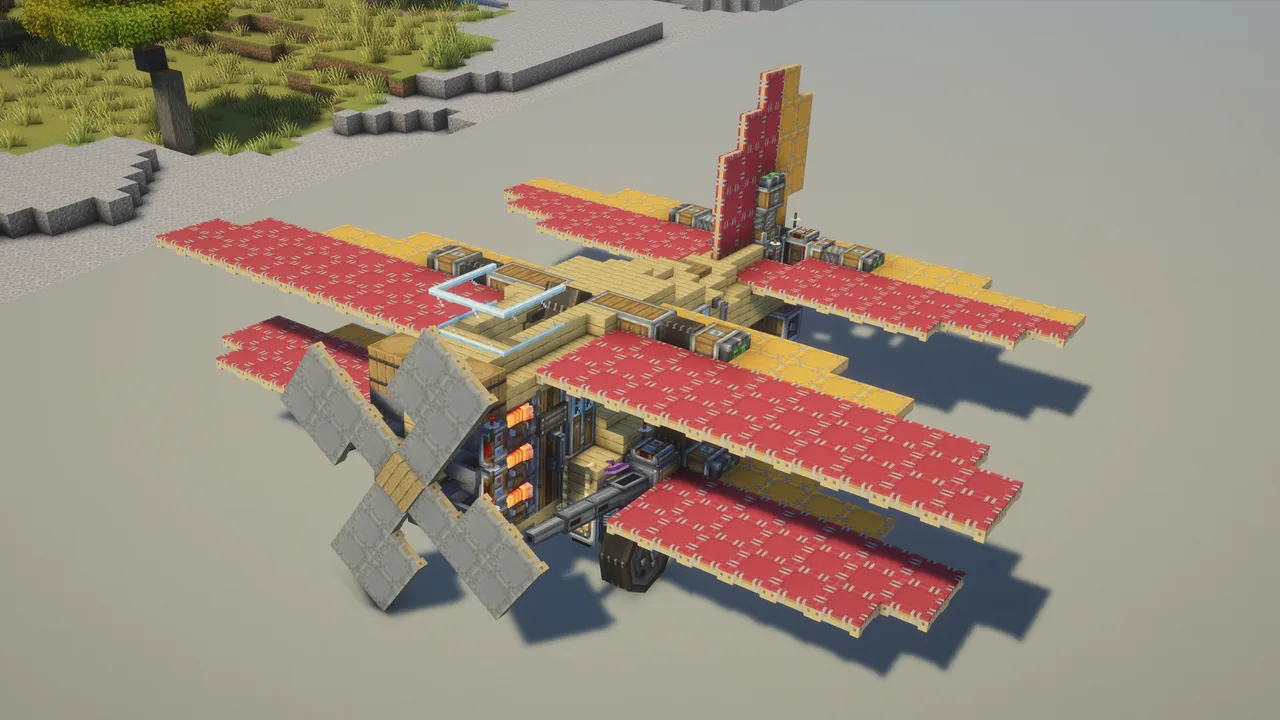 Bombastic Biplane 3000471 blocks · Idunoxd
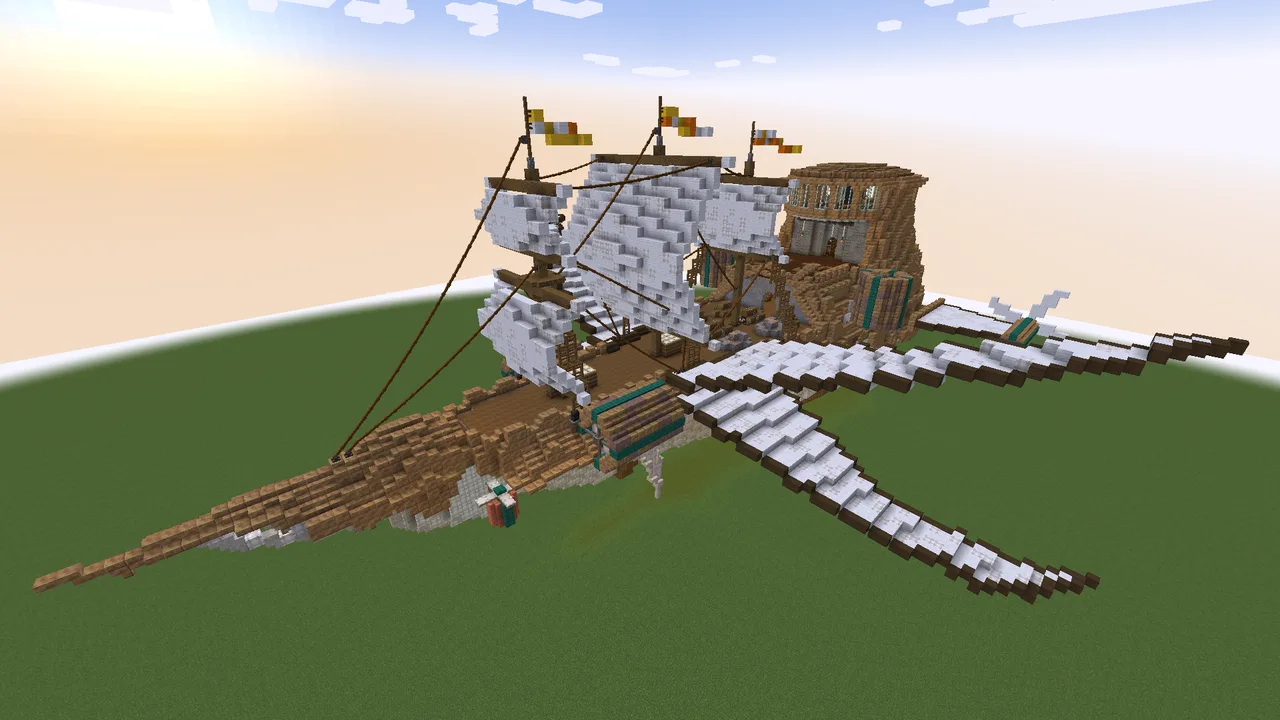 Uberswe's Airship in Aeronautics23,822 blocks · Arrachtan
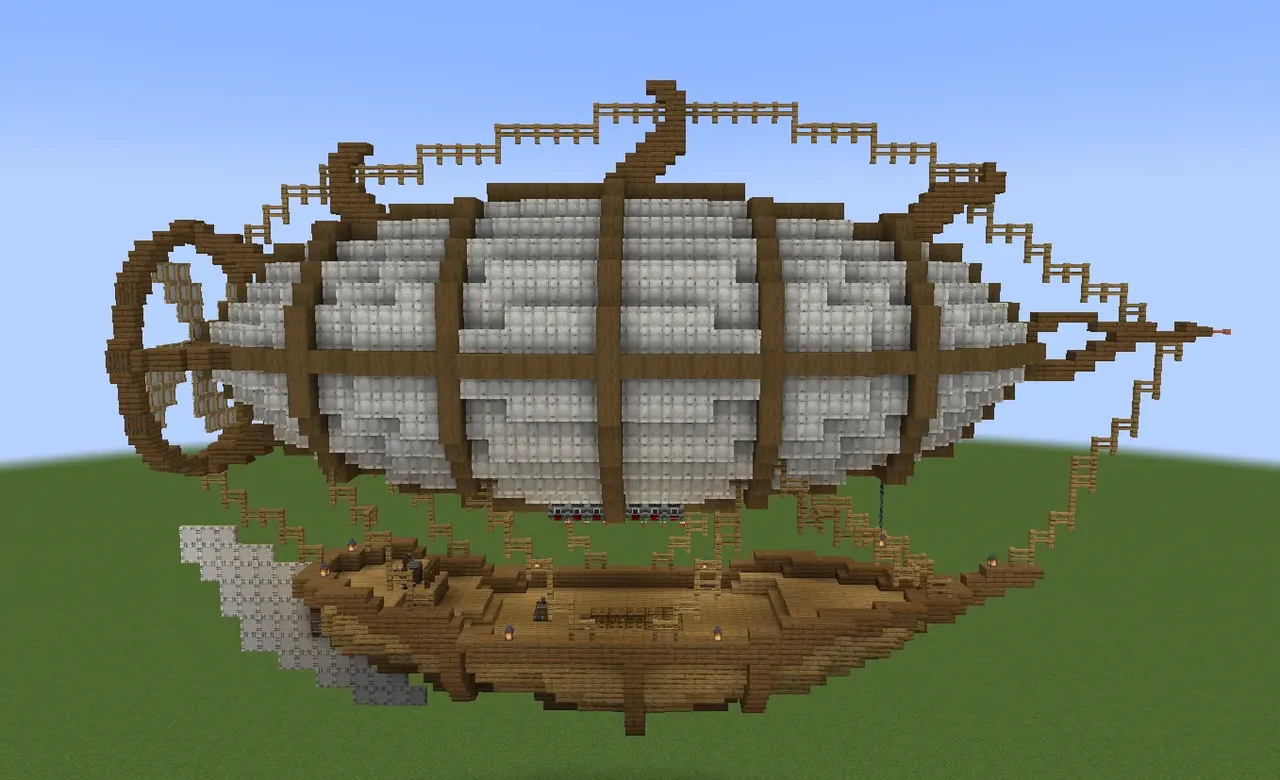 Steampunk Airship2,921 blocks · Jofrnoj
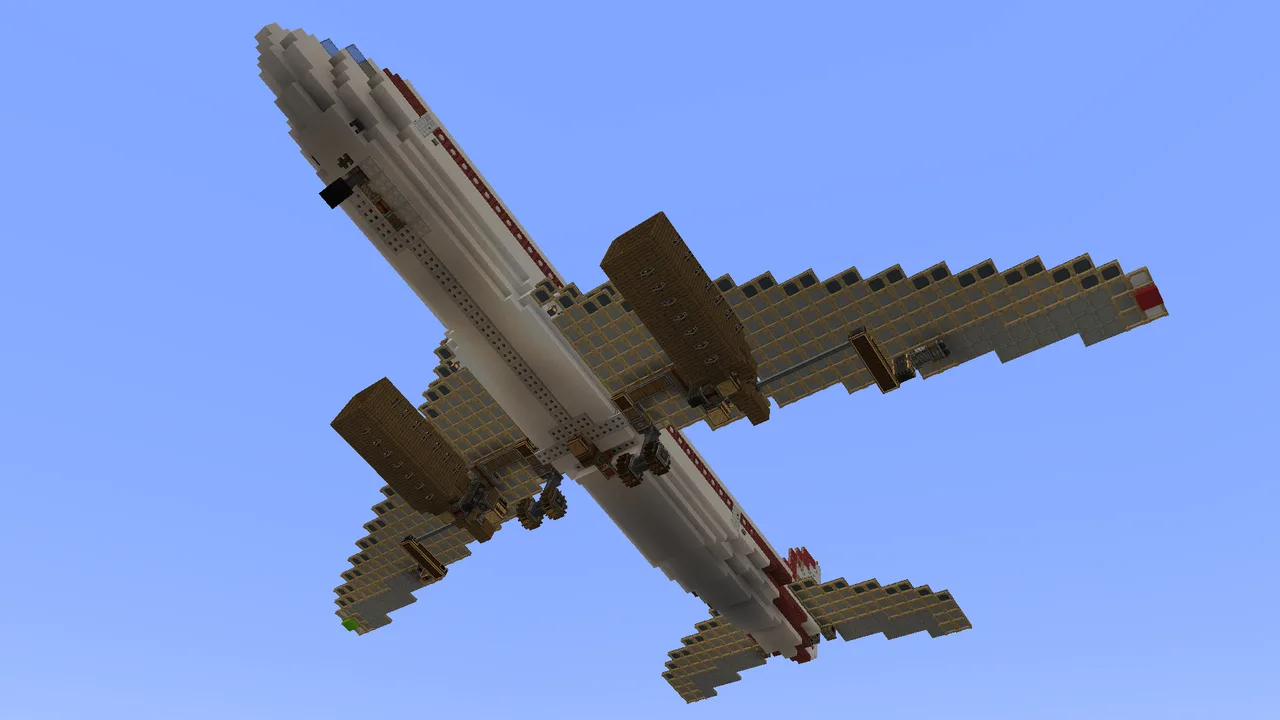 Steam powered Airliner (survival friendly, has interior)2,760 blocks · Whitestarliner737
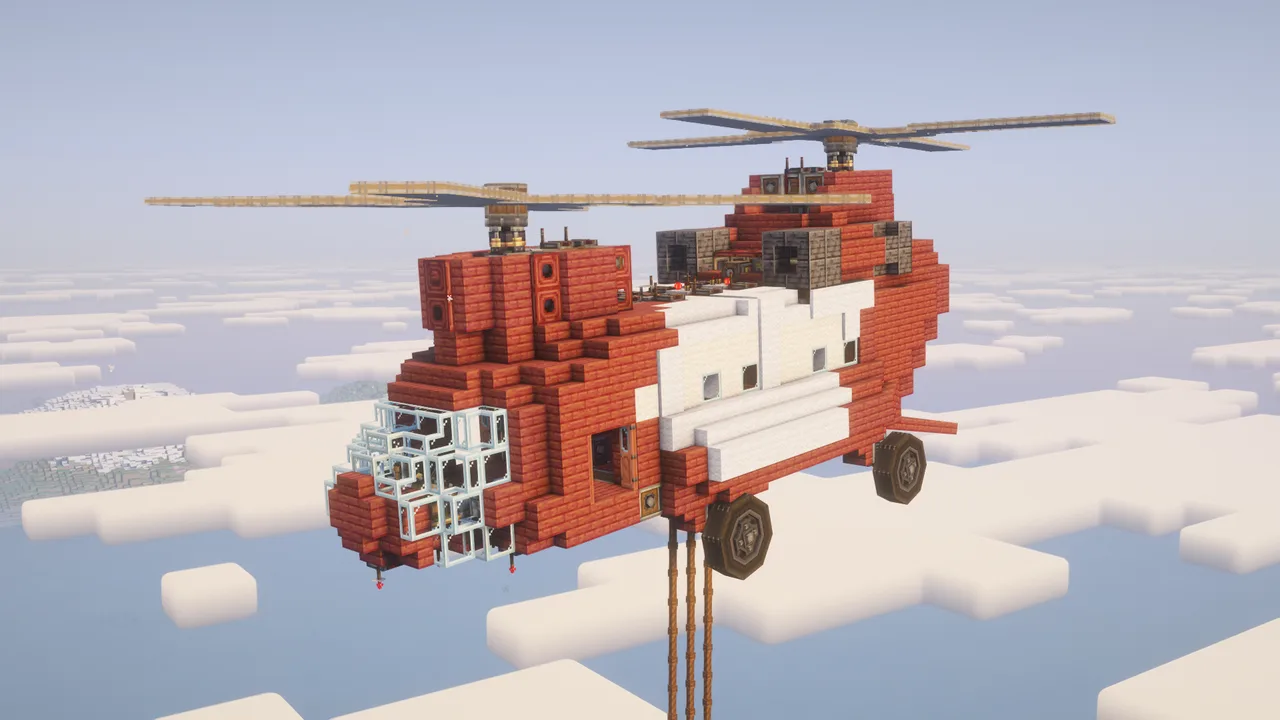 Chinook Helicopter With Shaft Vectoring (CH-47D)1,135 blocks · M4tty